

The Metrics That Matter
How to Measure the Unmeasurable

Today, I’m sharing a framework from my upcoming book, Spheres of Influence, ahead of its release in September. This approach transformed how I think about marketing.
Most of what shapes a buying decision in B2B can’t be tracked.
It’s not a click, a form fill or data in your CRM.
Instead, it’s the micro moments that shape buyer perception and preference. Like when someone hears your founder on a podcast, or sees your brand name dropped in a Slack group, or hears “you should check them out” in a WhatsApp thread.
It’s trust. Built up slowly and amplified by people.
Yet most marketing teams aren’t set up to capture any of it. Because they’re too busy measuring what’s easy;
Traffic
Downloads
MQL’s
And when those numbers dip? The CMO gets the heat, budgets get cut, and tactical short-term fixes get deployed at the expense of long-term sustainable growth.
And round and round we go.
The trap: when measurement defines strategy
This cycle compounds a downward spiral and slowly erodes long-term brand equity in favour of short-term optics.
This is the CMO trap.
The average tenure of a CMO now sits at just 18 months, according to research from Spencer Stuart, the shortest among the C-suite. It’s not for lack of talent. Today’s marketing leaders are some of the most forward-thinking, digitally fluent, and commercially-minded executives in their organisations. And yet, they’re increasingly falling short of expectations.
Why?
There’s a mismatch of expectations regarding what a CMO needs to do and what a CEO expects. In my experience, many CEO’s have conflated marketing with promotion and, by extension, expect immediate results. It's the CMO’s job to educate their CEO that this is very much not the case.
The 95:5 Rule (Ehrenberg-Bass Institute, 2021) reminds us that only 5% of your market is actively buying at any given time. The other 95%? They’re forming preferences, building trust, and discovering your brand long before they ever hit your landing page.
So if you only measure (and take action on) the bottom of the funnel, you’ll always be behind and you’ll leave so much opportunity on the table.
I learned this the hard way.
I wish I had known this earlier on in our journey of building ContentCal. Whilst we started with strong word-of-mouth growth, about two years in, we began spending more on Google and Facebook ads. At a particular scale, they were working well; we were spending about £10,000 per month, and the metrics all looked good.
However, the challenge came when we attempted to scale this. We had raised capital, and our £10,000 per month spend increased by 10x. At that scale, the economics started to break down. We had misunderstood the fundamentals of demand creation and demand capture. We had fallen into the trap that many businesses do and over-rotated our efforts (and budgets) to promotional activity.
Ads (and any promotional activity) are an essential part of the mix, but only when you have a foundation of organic, word-of-mouth-driven growth.
To help us reprioritise and make the case to our investors, I created a quarterly influence impact report to demonstrate the impact that these often overlooked metrics can have on the health of a business.
We needed a better lens.
We needed reporting that reflects how buying actually happens. To track how influence is impacting our market’s preference for our product, to shine a light on how we are creating demand in our category and to demonstrate how trust, not clicks, drives decisions
That’s why I built this:
The Quarterly Influence Impact Report
A free Google Sheets template to track what actually moves the needle.
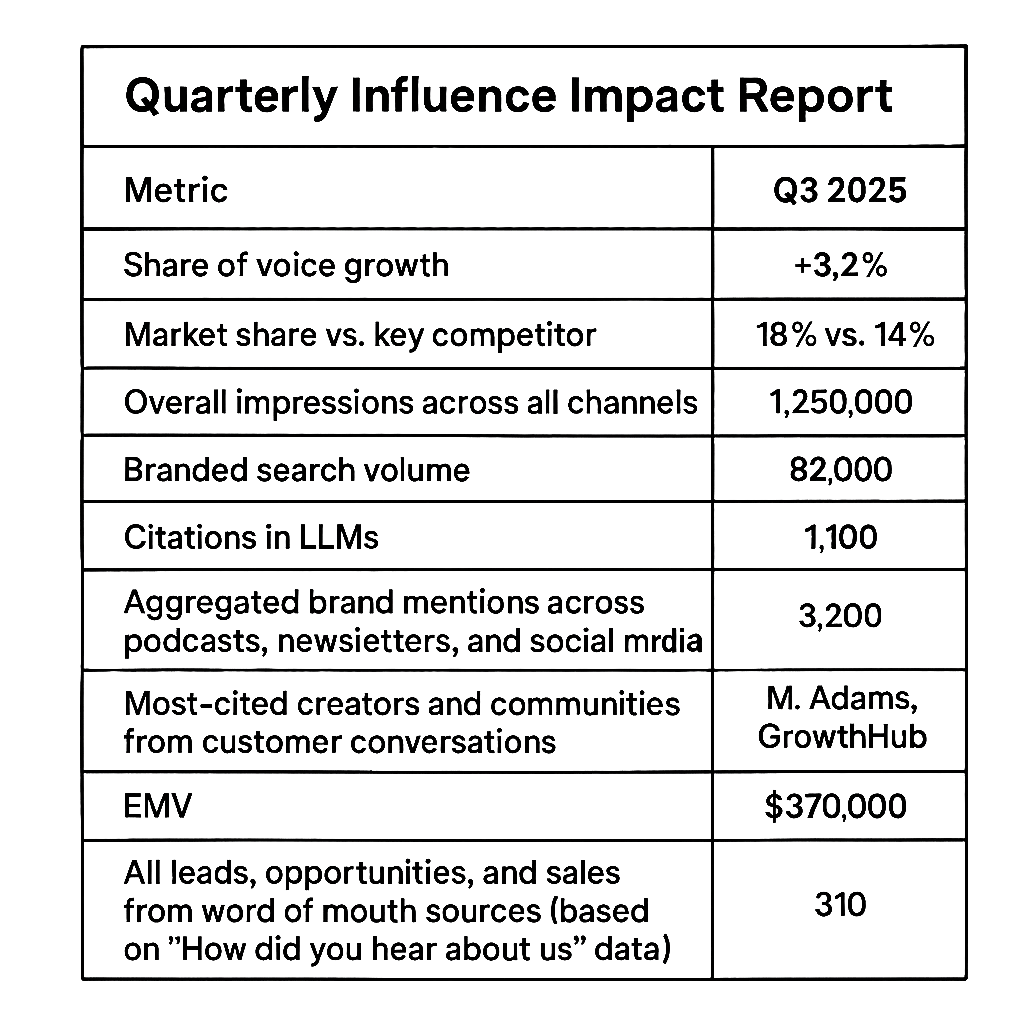
Here’s what it helps you capture:
Share of Voice growth: Are we being talked about more than our competitors?
Market share vs SOV: Are we gaining presence faster than market share?
Branded search volume: Are people looking for us more often?
LLM citations: Are we being surfaced in AI tools like ChatGPT and Perplexity?
Mentions across social, podcasts & newsletters: What are the trusted voices saying about us?
Creator and community references: Who’s recommending us in the spaces our buyers trust?
Earned Media Value (EMV): How much is our unpaid influence worth in ad terms?
Word-of-mouth sourced leads: What’s the ROI of trusted recommendations?
How to use it:
Copy the template into your Google Sheets account
Update it quarterly (not monthly, patterns need time to emerge)
Gather qualitative data like “How did you hear about us?” from open-text fields and customer conversations
Use it to reshape internal conversations with your leadership team and investors—from “What did we spend?” to “Where are we growing influence?”
🔗 Click here to download the free template
If you're a CMO, founder, or marketing leader trying to make the case for building long-term brand equity in a short-term world, this is your ally.
Remember the fundamental marketing laws: if your share of voice is greater than your market share, you will grow. And, if your share of voice is bigger than that of your competitor, you will take their market share.
It’s not easy, but it’s simple. Use it to start changing the conversation inside your company.
Let me know how you get on with it, I’d love to hear if it helps you too!